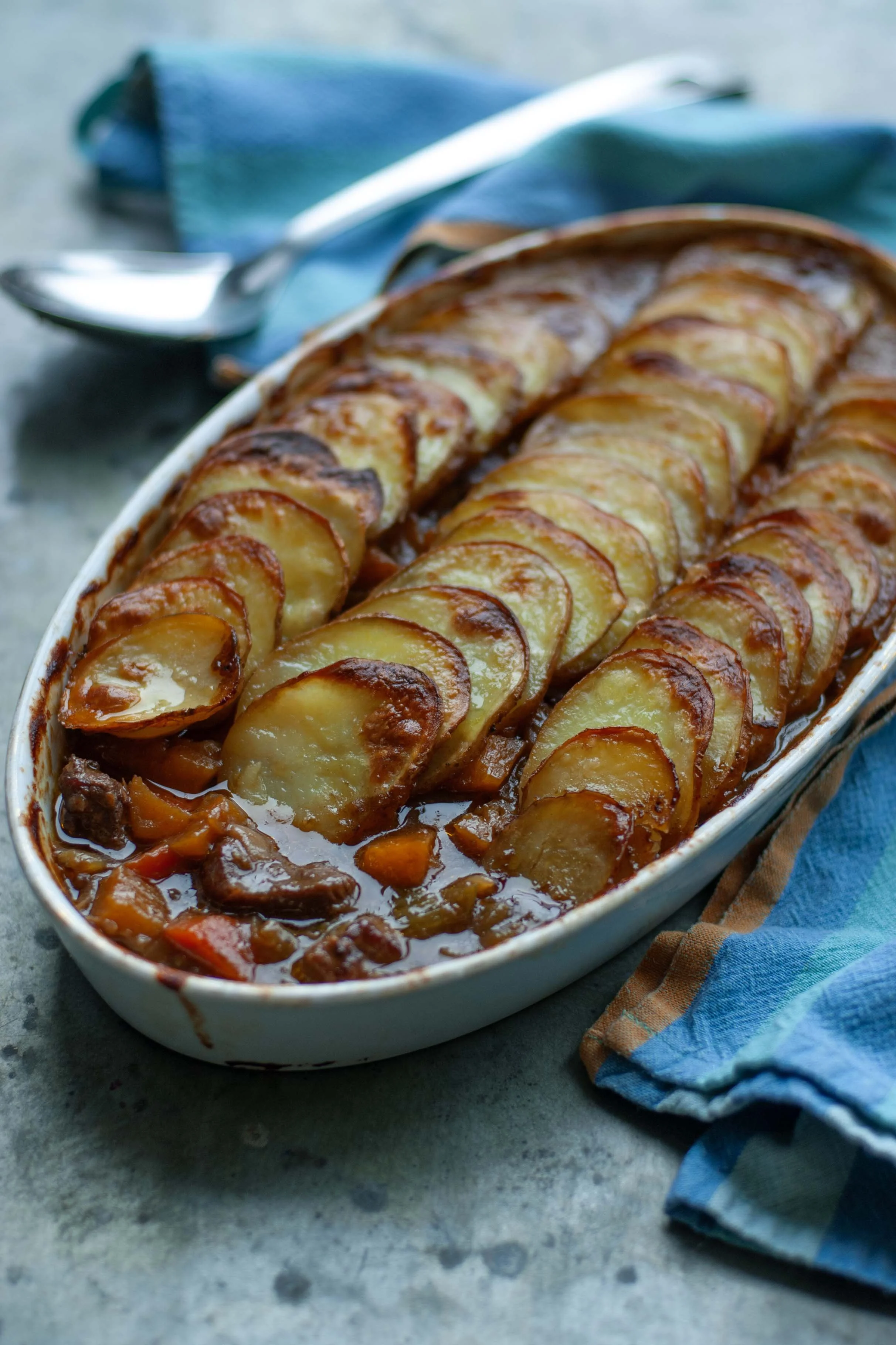
Hogget hotpot
This classic British one-pot dish is made with tender pieces of hogget, winter vegetables and a rich gravy topped with thinly sliced potatoes. Serve with steamed cabbage.

MAKES about 1215g dried porcini mushrooms
4 tablespoons olive oil
2 onions, finely chopped
4 celery stalks, finely chopped
700g diced hogget shoulder
Salt and freshly ground black pepper
1 heaped tablespoon plain flour (use gluten-free if required)
400ml beef or lamb stock
1 tablespoon sun-dried tomato paste
3 cloves of garlic, crushed
2 sprigs of thyme (or 1 teaspoon dried)
2 sprigs of rosemary
2 bay leaves
3 carrots, chopped
1 turnip, finely chopped
1 tablespoon dark soy sauce
2 large red potatoes, scrubbed and thinly sliced
Preheat the oven to 160˚C (140˚C fan). Put the dried mushrooms into a bowl, pour over 100ml boiling water and leave to soak for about 20 minutes.
Heat 2 tablespoons of the oil in a flameproof casserole set over a medium-low heat, and gently fry the onions and celery until the onions are softened but not browning.
Meanwhile, heat a tablespoon of the oil in a large frying pan set over a high heat. Season the hogget pieces with salt and brown in batches, transferring them to the casserole.
Sprinkle the flour over the meat and vegetables, and cook for a couple of minutes. Add the stock, tomato paste, garlic, herbs, carrots, turnips and soy sauce. Drain and roughly chop the soaked mushrooms, and add them and their soaking water to the casserole. Stir well and bring to the boil, cover and cook for about an hour until the meat is just tender.
Remove the casserole from the oven, and increase the heat to 180˚C (160˚C fan). Taste the gravy for seasoning, then arrange overlapping slices of potato on top. Brush with oil, season well and bake for 40 minutes until the potatoes are tender and nicely browned.
-
Electric For best results, keep the steam vent closed.
Wood-fired The oven dial should read mod.
Recipe from my book Winter

Celeriac soup with blue cheese croutons
Celeriac, introduced to Britain in the eighteenth century, is a turnip-rooted relative of celery that has a slightly sweeter flavour. It can be eaten shredded raw in salads, steamed and puréed, or used to make a delicious thick, velvety soup such as this one. The blue cheese croutons give a delicate savoury richness.

SERVES 650g butter
2 onions, chopped
2 celeriac, peeled and chopped
2 carrots, chopped
Salt and freshly ground black pepper
1½ litres vegetable stock
For the croutons
6 slices of sourdough bread
120g Pevensey Blue or other creamy blue cheese
Heat the butter in a large pan, and gently cook the onions, celeriac, carrots and seasoning with a lid on for about 15 minutes until they just begin to soften but not colour. Add the stock and bring to the boil. Reduce the heat, cover and simmer for about 20 minutes until the vegetables are tender.
Purée the soup in a liquidiser (or using a hand-held blender) until smooth. Return to the pan, and keep warm while you make the croutons.
Preheat the grill to medium, and, when it is hot, toast the bread. Spread each slice generously with blue cheese, and grill until the cheese has melted and is just starting to colour around the edges.
To serve, ladle the soup into bowls, and top each serving with a crouton.
Recipe from my book Winter

Cabbage cake
This is an attractive way to serve beautiful leafy green Savoy cabbage, and perfect for entertaining, as it can be made in advance and reheated.

SERVES 81 × roughly 500g Savoy cabbage
Salt and freshly ground black pepper
25g butter
1 tablespoon olive oil
400g spinach, washed
½ whole nutmeg, grated
Line a loose-bottomed 23cm cake tin with cling film. Pick off the outer dark green leaves of the cabbage – enough to line your cake tin – and cut away the thick central stalks. Blanch the leaves in boiling, salted water for about 5 minutes until tender and bright green, then refresh in iced water and dry them on a clean tea towel.
Finely shred the remaining cabbage. Heat the butter in a large frying pan over a medium-high heat, and add the shredded cabbage and some seasoning. Put a lid on the pan and let the cabbage steam until just tender. Remove the cabbage from the pan, and spread out on a tray to cool.
Heat the olive oil in a large saucepan over a high heat, and add the spinach. Stir until the spinach wilts, then spread it out on a tray to cool. Squeeze out any excess water, and chop it roughly. In a bowl, mix the cooled shredded cabbage and chopped spinach with some seasoning and the nutmeg.
Use the blanched cabbage leaves to line the base and sides of the cake tin, overlapping if necessary. Spoon in the spinach and cabbage filling, and fold any overhanging leaves over onto the top. Cover with cling film, then put 2 plates on top to press down the cabbage. Stand the cake tin on a tray to catch any liquid that drains out, and chill until needed.
To serve, preheat the oven to 190˚C (170˚C fan). Remove the cling film, turn out the cabbage cake onto an ovenproof plate and cut into wedges (it is easier to cut when cold). Bake for 20 minutes, or until piping hot.
-
Electric For best results, keep the steam vent closed.
Wood-fired The oven dial should be between mod and hot.
Recipe from my book Winter

Mince pies with frangipane
Almondy frangipane adds a nice twist to the traditional mince pie. You can freeze these uncooked and bake from frozen, but they will take a little longer to cook.

MAKES about 12100g butter, at room temperature
100g icing sugar
2 teaspoons plain flour
100g ground almonds
2 eggs
300g mincemeat
25g flaked almonds
For the pastry:
175g plain flour
25g icing sugar
85g fridge-cold butter
1 egg, beaten
First, make the pastry. Put the flour, icing sugar and butter into a food processor and whizz to make fine breadcrumbs (or rub in by hand). Add the egg and 2 teaspoons cold water, and whizz (or stir) until it begins to come together into a soft dough, adding a little more water if necessary. Wrap the pastry in cling film, and leave to rest in the fridge for about 20 minutes.
Preheat the oven to 190˚C (170˚C fan). For the frangipane, beat together the butter and icing sugar in the food processor, then add the flour, ground almonds and eggs. Process until smooth.
Roll out the pastry on a lightly floured surface to a thickness of about 3mm. Cut into circles with an 8cm round fluted cutter, and gently press into a 12-hole non-stick muffin tin. Spoon about a dessertspoon of mincemeat into each one, pressing down to create an even layer.
Spoon (or I find it’s actually easier to pipe) over the frangipane to make a thick layer, making sure you cover the mincemeat. Scatter with the flaked almonds, and bake for about 25 minutes until golden. Just before serving, dust with icing sugar.
-
Cook the pies directly on the bottom of the oven.
Electric For best results, keep the steam vent closed.
Wood-fired The oven dial should read between mod and hot.
Recipe from my book Winter